Bill Compton
A History of the Vampire in Popular CultureBill Compton is the new vampire whose arrival in Bon Temps draws Sookie Stackhouse into the hidden social world of the undead. Their connection is not a simple rescue romance: it places Sookie between vampire predation and human exploitation, while Bill becomes the figure through whom True Blood overturns familiar vampire rules and links supernatural intimacy to civil-rights politics.
Identity and Introduction
Bill appears in True Blood as a vampire living openly in a small town in Louisiana, a development made possible by the invention of synthetic Tru Blood, a blood substitute that supposedly allows humans to feel safe in vampire company. The premise carries an immediate tension. Vampires have spent centuries feeding, killing, and hiding from human persecution, yet public disclosure does not erase the habits or dangers of their earlier existence. Bill therefore arrives as both a sign of social change and a reminder that coexistence remains conditional.
His first importance lies in the effect he has on Sookie Stackhouse. A telepathic waitress and lifelong outsider, Sookie has learned to distrust other people’s motives because she can hear their thoughts. Bill is unusual to her because his mind does not intrude upon her in the same way, and his presence offers the possibility of intimacy with someone who can withstand the very ability that has isolated her. The attraction is mutual, but the circumstances prevent it from becoming an uncomplicated human romance: Bill is a vampire, Sookie is mortal, and the culture around them expects humans to be treated as sources of blood.
Relationship with Sookie Stackhouse
Sookie is romantically entangled with Bill, but she refuses the passive role that vampire fiction often assigns to the human beloved. She is not prepared to become a walking buffet for animalistic vampires, and her quiet manners conceal a firm resistance to manipulation. Her outsider status has made her cautious rather than helpless; she takes calculated risks because she is confident enough to judge danger for herself.
Bill’s relationship with Sookie is tested immediately when Denise and Mack Rattray recognize him as a vampire and plan to steal his blood for sale on the black market. After reading their thoughts in the diner, Sookie understands that Bill is in serious danger and decides to intervene. She wraps a silver chain around her neck before entering the confrontation, demonstrating that her willingness to help him is not naïveté. She survives the ensuing bloody fight only by drinking some of Bill’s blood for its healing properties. Initially repulsed, she becomes eager as the blood enters her body, turning an act of emergency care into an intimate and potentially addictive exchange.
The next day, Sookie discovers that Bill’s blood has heightened her human senses. Her strength, sight, hearing, and smell all increase; she can even detect a tiny crumb lodged beneath furniture in her grandmother’s immaculate house. Bill also tells her that continued consumption could affect her sex life. The exchange thus gives Sookie temporary power while exposing the seductive cost of dependence. Vampire blood is valuable in this world not merely because it heals, but because it offers mortals an escape from human physical limitation.
Blood, Myth, and Vampire Rules
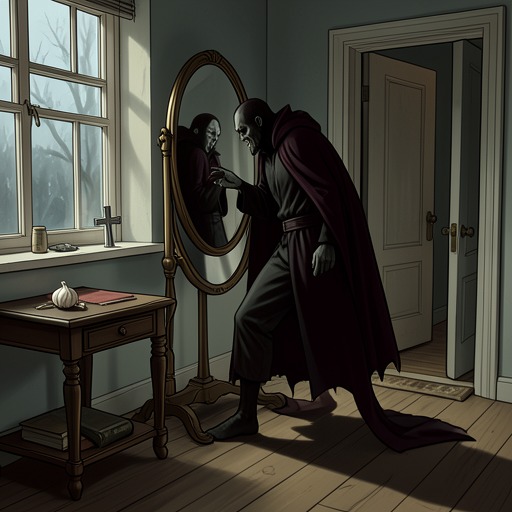
Bill serves as an articulate dismantler of traditional vampire mythology. When Sookie notices that he can see his reflection, he explains that vampires invented false beliefs about mirrors in order to make humans dismiss the possibility that they were vampires and thereby preserve their concealment. Holy water is merely water, and crucifixes are dismissed as geometry. Garlic alone retains a limited connection to reality, irritating vampires without possessing the absolute power assigned to it by older stories.
This brief unmaking of inherited rules makes Bill more unsettling rather than less. The familiar signs that would allow humans to identify a vampire no longer function reliably, so an apparently ordinary person may conceal an undead identity until showing fangs. True Blood consequently treats folklore as a tool of vampire self-protection: myths are not only stories imposed upon vampires by humans but also deliberate fictions produced by vampires themselves.
Bill’s blood also reverses the usual direction of vulnerability. Human blood is commonly represented as a vehicle for disease, contamination, and danger, whereas vampire blood in Sookie’s world can produce healing, heightened senses, and erotic pleasure. Its risks are different. Humans may become addicted to its powers, and some vampires are hunted by people seeking to sell their undead vital essence. Bill is therefore endangered not only by his own species’ predatory reputation but also by mortals who turn vampirism into a commodity.
Cultural and Political Significance
Through Bill and Sookie, True Blood reframes the vampire as a minority demanding recognition. The series’s language of “coming out of the coffin” and “God Hates Fangs” adapts the vocabulary of gay-rights struggles, while the vampires’ public emergence recalls the risks and promises of coming out. Bill’s presence embodies that contradiction: he represents a community seeking equality, yet the history of vampire feeding and killing makes trust difficult and exposes humans to genuine danger.
Sookie’s connection with him sharpens the political analogy because she occupies an outsider position of her own. Her telepathy has separated her from ordinary human society, but it also makes her unusually alert to manipulation. She can recognize the motives of people who intend to exploit Bill, resist the assumptions of vampire society, and refuse to treat kindness as weakness. Her bond with Bill therefore becomes a meeting point between two forms of otherness rather than a simple passage from normality into the supernatural.
Place in Vampire Fiction
Bill belongs to a modern phase in which vampires are no longer restricted to the role of monsters. Earlier literary traditions established the elegant nocturnal predator in Carmilla and gave the vampire a fully developed personality and personal agenda through Count Dracula; later portrayals allowed vampires to become sympathetic, comic, politically marginalized, or openly integrated into everyday life. Bill participates in this expansion while retaining the genre’s central instability: he can be a romantic partner, a source of healing, a representative of an oppressed group, and a dangerous immortal whose society has survived by feeding on humans.
His significance consequently depends on unresolved contradiction. Tru Blood promises peaceful coexistence, but a synthetic diet cannot automatically undo the habits of eternal lifetimes. Bill’s relationship with Sookie demonstrates the possibility of trust across the human-vampire boundary, while the attack by the Rattrays proves that blood remains a source of violence even when vampires seek legal and social acceptance. He is neither a straightforward redeemer nor merely a concealed predator; he is the character through whom True Blood asks whether a society can call for equality while still carrying the history of harm that made secrecy seem necessary.